Licensed & insured · NC electrical contractor
Mon–Fri 8AM–5PM · Emergency 24/7
Licensed & insured · NC electrical contractor
Mon–Fri 8AM–5PM · Emergency 24/7
Our EV charger installation Fayetteville NC service puts Level 2 home charging on a dedicated 240-volt circuit, with a load calculation before we quote, so you know whether your panel can carry it before you commit to anything. Permitted, inspected and fitted by licensed electricians.
Miles of range per hour
Dedicated circuit
Licensed & insured
Cities served
Before any EV charger installation Fayetteville drivers book, know this: the cord that came with the car works. It just does not work fast enough for most people’s week.
That cord is Level 1 charging — a standard 120-volt outlet, adding somewhere around three to five miles of range per hour. For a plug-in hybrid with a small battery, that is genuinely fine. For a full electric vehicle and a normal commute, you will wake up most mornings short of where you wanted to be.
Level 2 EV charger installation Fayetteville homes get runs on a dedicated 240-volt circuit and typically adds 25 to 30 miles of range per hour. That turns EV charging into something that happens overnight without you thinking about it. DC fast charging — the kind at highway stops — is commercial infrastructure and is not installed at homes, so if you have seen it quoted for a driveway, something is wrong with the quote.
EV charger installation Fayetteville, NC is mostly a question of whether your electrical service has room for that circuit. That is the next section, and it is the one that decides the price.
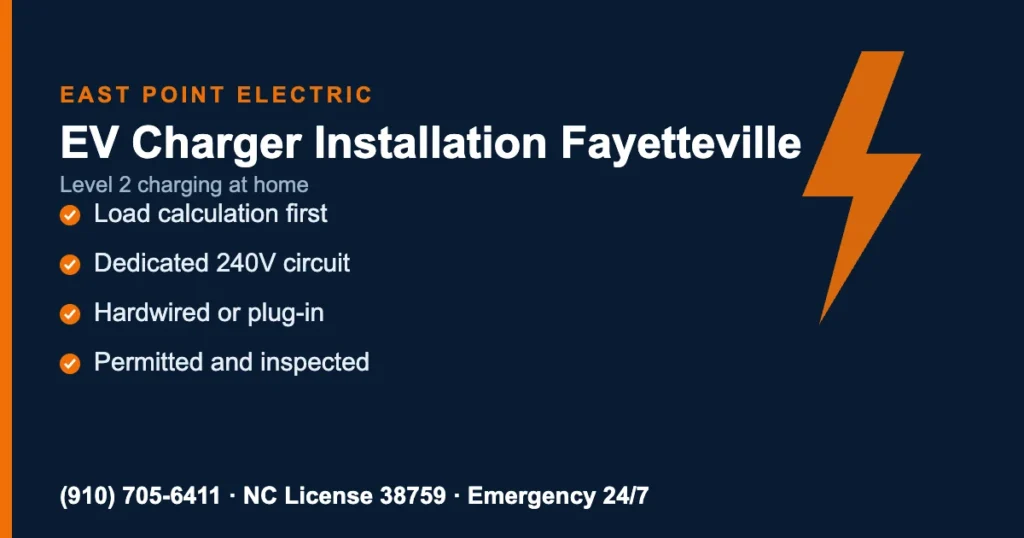
Most pages stop at “you might need a panel upgrade”. For EV charger installation Fayetteville homes, there are three possible answers, and two of them are cheaper than that.
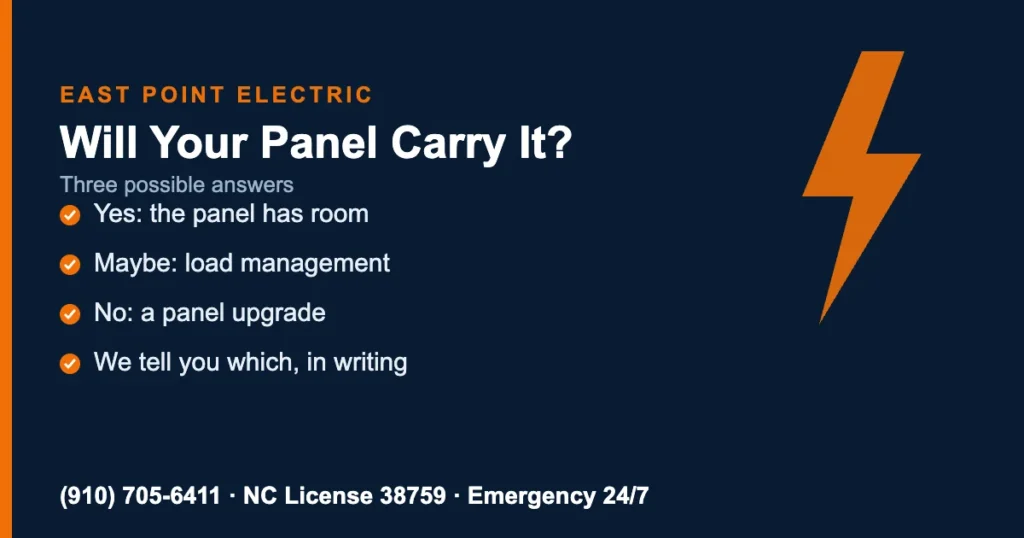
A licensed electrician adds up what the house already draws — heat pump, range, water heater, dryer, everything — and what the charger will add, then compare it against your service size. A charger is a continuous load, which is why a 40-amp charger needs a 50-amp circuit rather than a 40-amp one. That rule catches people out, and it is why a guess from a photo of the panel is not an answer.
A 200-amp service with free breaker space is usually a few hours’ work. A dedicated Level 2 circuit, a breaker, a run to the garage, and the charger mounted where you actually want it rather than where the cable happened to reach.
An electrical panel upgrade is one answer, and sometimes the right one. But a load management device can let a charger use spare capacity without ever exceeding your service — often at a fraction of the cost of a service upgrade. A lower-amperage charger is the third option, and for most drivers it still delivers a full charge overnight.
If load management solves it, we will tell you that instead of quoting a panel upgrade. If your service genuinely cannot support the charger you want under any arrangement, we will tell you that too, before you have bought anything.
Two decisions that come up on every EV charger installation Fayetteville job, and that almost nobody explains before quoting.
J1772 has been the long-standing connector on non-Tesla vehicles in North America, while Tesla vehicles use their own. The connector landscape has been consolidating, and most modern chargers handle it through either the cable supplied or an adapter. Whether you drive a Tesla or anything else, tell us what you have and we will make sure what goes on the wall fits it.
For EV charger installation Fayetteville jobs, most customers buy the unit themselves or receive one with the vehicle — a Tesla Wall Connector, a J1772 unit or any other brand. Our quote covers the circuit, breaker, run, mounting, permit and inspection — the charger unit itself is quoted separately if you want us to supply it, so you always know which is which.
Worth raising at the survey. On EV charger installation Fayetteville jobs, two chargers on one service is exactly the situation load management is designed for, and planning the second one now is much cheaper than adding it as an afterthought.
Where you park decides most of the labor on an EV charger installation Fayetteville job. These are the common setups we see across Cumberland County, and what each one involves.
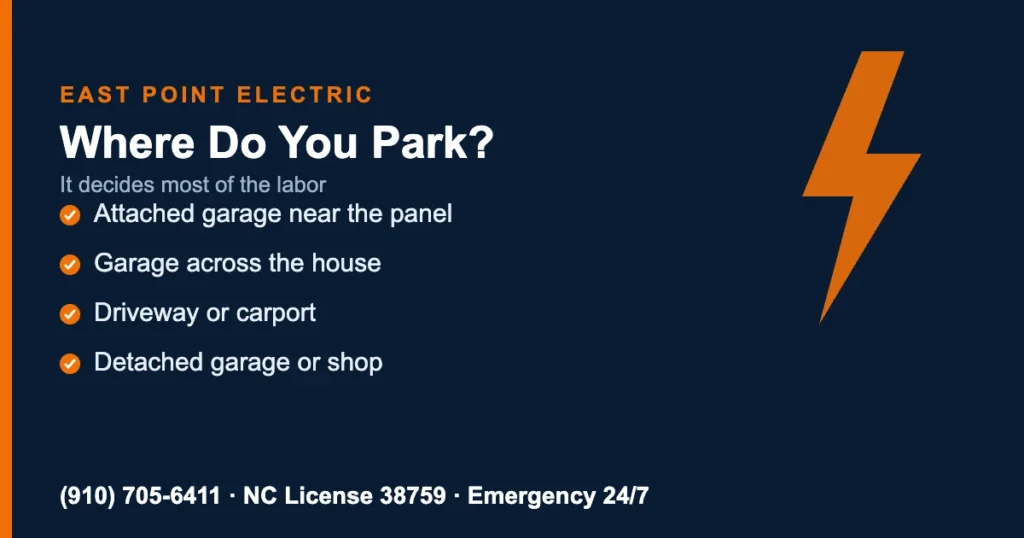
Attached garage near the panel. The simplest job. A short run from the panel to the garage wall, a correctly sized breaker and the charger mounted where the cable reaches the charge port comfortably.
Garage on the far side of the house. Common in ranch homes around Terry Sanford and Westover. The cable runs through the attic or crawl space, which adds time but usually no drywall work.
Driveway or carport. An outdoor-rated, hardwired unit or a weather-resistant receptacle with an in-use cover, on a post or the exterior wall. In this climate we always specify a unit rated for outdoor use and summer heat.
Detached garage or shop. Usually a buried feed and sometimes a sub-panel at the building. Priced from the distance and the trench route, and worth combining with shop lighting and outlets.
Townhomes and HOAs. Some communities in Jack Britt and the newer subdivisions have rules on exterior equipment. Check with the HOA early; we can provide the layout they will ask for.
Rental and military housing near Fort Bragg. Tenants need the landlord's written approval. We can quote the landlord directly and keep the paperwork simple.
The charger itself is the predictable part of EV charger installation Fayetteville pricing. What varies is the run from the panel to wherever you park.
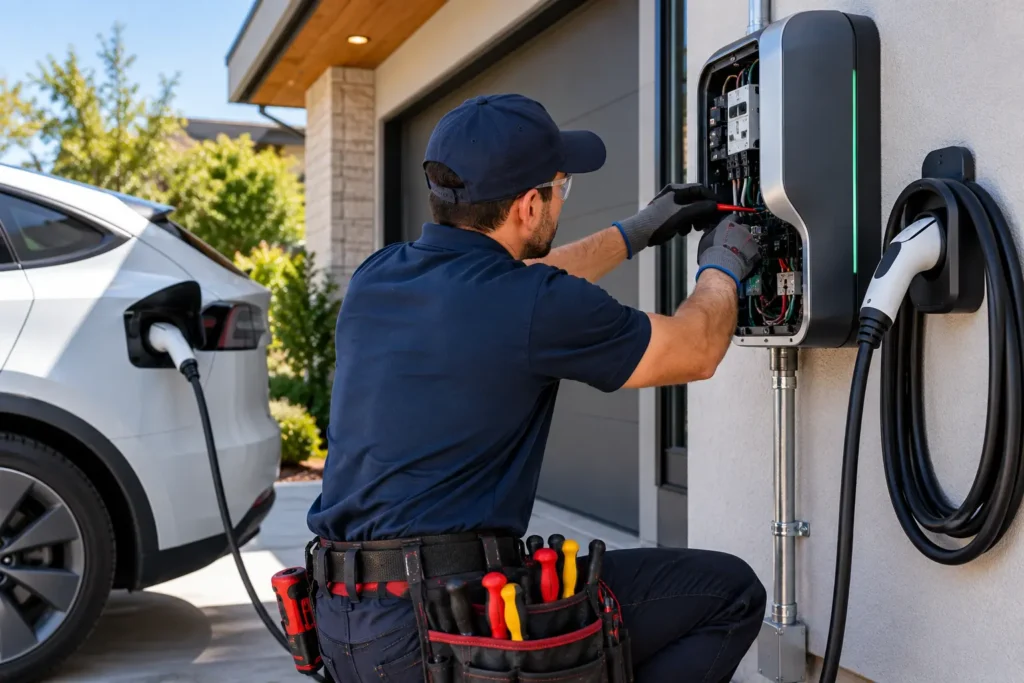
A Fayetteville-specific cost calculator puts most EV charger installation Fayetteville projects at $776–$2,425, with a typical figure around $1,261 and a permit allowance near $450. A North Carolina installer network quotes $400–$1,500 installed for two to four hours of work, and a regional electrician publishes a wider $700–$5,000 range that reflects jobs needing panel work.
Where a panel upgrade is genuinely needed for EV charger installation Fayetteville, it is quoted separately — nationally around $1,500–$4,000 — rather than buried inside the charger price.
The federal home charger tax credit (Section 30C) ended for chargers placed in service after June 30, 2026, so new installs no longer qualify. Some utilities and charger makers still run their own rebates from time to time. Check with your power company before you buy, and ignore older articles that still quote the federal credit.
Most straightforward EV charger installation Fayetteville jobs are a few hours on site. The permit and inspection are what set the calendar.
Every EV charger installation Fayetteville job starts here. We look at the panel, the service size, where you park and how the cable would get there. That produces a clear answer on capacity and a route, rather than a number over the phone.
Including whether the charger unit is supplied by you or by us, and whether load management or a panel upgrade is in scope. Nothing starts until you approve it.
An EV charger installation Fayetteville circuit is permitted work, and it has to be inspected before the charger is put into service. Anyone offering to skip that is offering you an uninspected 240-volt circuit, which no licensed electrician should do.
Dedicated circuit, correctly sized breaker, cable run and the unit mounted where you want it. A few hours for a typical garage install.
County sign-off, then we run a charge to confirm everything works and walk you through the unit’s amperage settings and app so it is doing what you paid for.
If walls are open for any reason, EV charger installation Fayetteville wiring is the cheapest it will ever be.
Recent code work distinguishes between a circuit that is fully installed and ready to use and one where only the capacity and pathway are reserved. Either is far cheaper done during construction than retrofitted through finished walls afterwards.
Running conduit and reserving panel capacity during new construction wiring costs very little. On a spec home it is a feature you can advertise for almost nothing.
If a garage, addition or kitchen is already being opened up for remodel wiring, adding the charger circuit at the same time shares the labour and the permit visit.
We handle EV charger installation Fayetteville, NC and in fifteen more cities across Cumberland, Harnett, Lee, Wake, Sampson, Bladen and Hoke counties. Newer subdivisions around Fuquay-Varina and Raleigh usually have 200-amp service and free breaker slots, so those jobs tend to be quick. Older housing in Cumberland County more often needs the capacity conversation first — which is exactly why we run the load calculation before quoting.
TALK TO AN OWNER
Hours
Local cost data puts most EV charger installation Fayetteville projects between roughly $776 and $2,425, with a typical figure around $1,261 including a permit allowance. Jobs needing a panel upgrade or a detached garage run higher. You get a firm written figure after the site visit.
Not always. A 200-amp service with free slots usually takes a charger without any change. Where capacity is tight, a load management device or a lower-amperage charger often solves it far more cheaply than a service upgrade. The load calculation decides which.
A typical Level 2 EV charger installation Fayetteville garage job is a few hours on site. What extends the calendar is the permit and the inspection, both of which run on the county schedule rather than ours. Panel work or a detached garage adds a day.
Yes. Adding a 240-volt circuit is permitted work in this county and has to be inspected before the charger is put into service. We pull the permit as part of the job, and the record follows the house to closing.
Hardwired if you want the highest charging speed, a permanent tidy install or an outdoor location. A receptacle if you want to take the unit with you or swap it easily. Receptacle installs carry a GFCI requirement that affects the price, so we quote both.
Typically 25 to 30 miles per hour, against roughly three to five on a standard 120-volt outlet. The exact figure depends on your vehicle’s onboard charger and the circuit amperage, which is part of why the circuit is sized properly.
Yes. It usually means a buried or overhead feed to the outbuilding, and sometimes a sub-panel there, which we price separately so you can see what the distance is actually costing you.
Yes. Choose a charger rated for outdoor use, and hardwire it where possible rather than using a receptacle, since outdoor receptacles add weatherproofing and GFCI requirements. We mount it where the cable reaches the charge port without crossing a walkway.
The installation itself is usually a few hours for a typical garage. The calendar is set by the permit and the inspection, which follow the city or county schedule.
The federal home charger credit (Section 30C) ended for chargers placed in service after June 30, 2026. Check with your utility for any local rebate before you buy.
It depends on the circuit and the panel. A 40 to 50 amp circuit is common for Level 2. We set the charger to match the circuit and the load calculation, and show you the setting on handover.
Call (910) 705-6411 for EV charger installation Fayetteville, NC. We run the load calculation, tell you honestly whether your panel needs anything, and put the price in writing before you buy a charger you cannot yet use.